Colony Copilot continuously analyzes your mouse colony and generates the husbandry actions required — eliminating avoidable vivarium costs and manual colony planning.
$22,000*
saved per year per colony
10 hrs*
of manual reviews eliminated weekly
Expertise
embedded in software
* See savings breakdown below.
Pilot program opening for select research laboratories
What Makes a Mouse Colony So Expensive?
Your colony isn't expensive because you're doing more science. It's expensive because no one can watch 200 cages closely enough to catch waste the moment it happens.
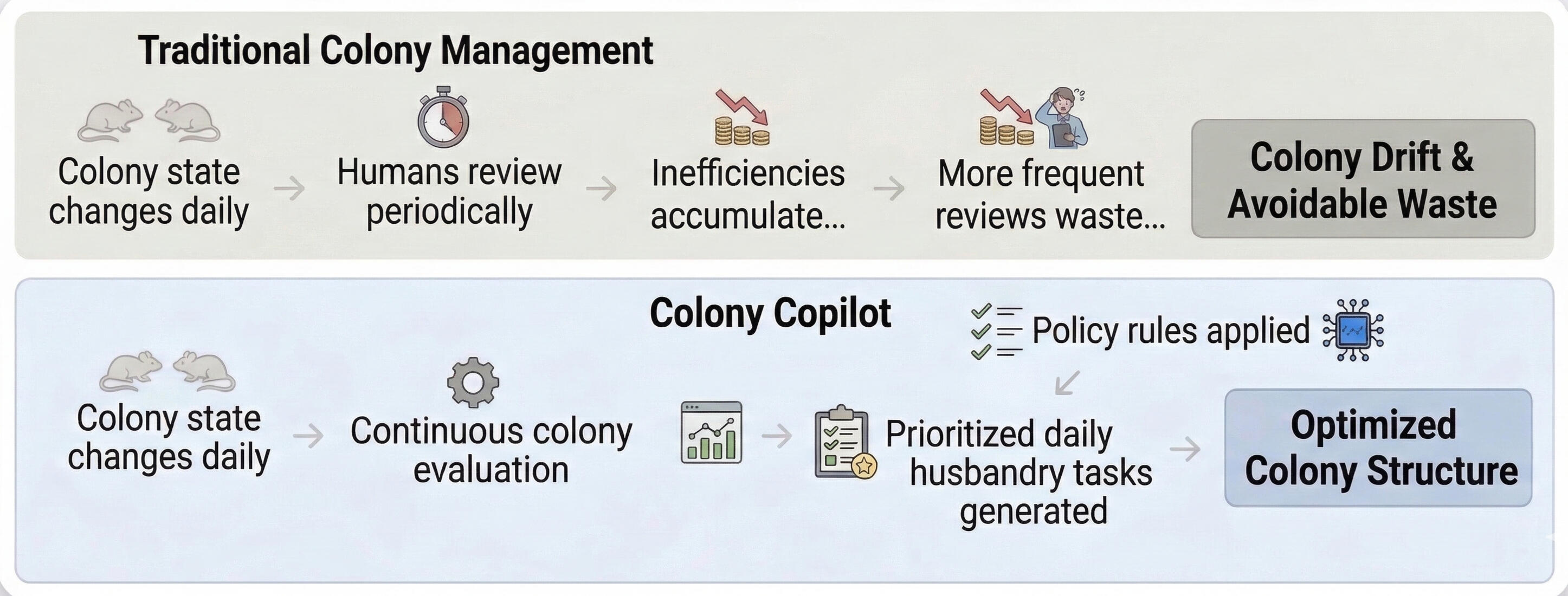
Mouse colonies naturally drift. Litters mature, genotypes resolve, and cages become underfilled as animals cross biological decision points. Manual colony reviews cannot keep up. Routine colony management already requires 5–10 hours per week to review inventories and plan husbandry actions — costing $5,700–$11,400 per year in technician time — yet inefficiencies still accumulate between reviews.In typical colonies, 15–30% of cages represent avoidable housing. In complex interbreeding colonies waste exceeds 40%. At roughly $1 per cage per day, even small occupancy gaps compound quickly into next month's vivarium bill.Colony Copilot stops this drift — continuously evaluating colony state and generating prioritized husbandry actions before costs accumulate.
How Much Colony Copilot Can Save
Illustrative Annual Savings Scenarios (per 100-cage colony). Example savings scenarios for a 100-cage colony based on common colony-management inefficiencies, estimated avoidable housing waste, and modeled technician review time.
Colony Type
Avoidable Per Diem Waste
Manual Colony Review Labor Cost
Total Annual Waste
Typical colony
$5,475 – $10,950
$5,720 – $11,440
$11K – $22K/year
Complex interbreeding colony
~$14,600
$5,720 – $11,440
$20K – $26K+/year
These figures are illustrative scenario estimates based on generalized operational assumptions. Actual savings will vary by colony structure, workflow, and housing costs.
How Colony Copilot Works
Traditional colony software records what happened. Colony Copilot evaluates your colony in real-time to trigger the exact husbandry actions needed today, eliminating waste before it accumulates.
Colony Copilot vs Traditional
Traditional Colony Software
📋
Colony state changes daily
Litters mature, genotypes resolve, cages drift
🗄️
Stores colony data — never acts on it
Data stored passively, no action triggered
👤
Periodic human review needed to find inefficiencies
5–10 hrs/week of manual planning
⏳
Inefficiencies accumulate between reviews
Waste grows undetected until next session
Result
Colony drifts & avoidable waste accumulate
Colony Copilot
📋
Colony state changes daily
Litters mature, genotypes resolve, cages drift
🔄
Continuous colony evaluation
Every cage, every day — no manual review needed
⚙️
Encoded expertise triggers the right action at the right moment Only Colony Copilot
✅
Prioritized husbandry tasks generated daily or on-demand for technician
Per diem waste eliminatedManual planning goneCage occupancy optimizedNo strain lossLab-specific policies appliedExpertise encoded in the systemFull range of husbandry activities
Result
Optimized colony structure — waste caught before it bills
Traditional software records what happened. Colony Copilot decides what needs to happen next.
Who It's For
Principal Investigators, lab managers, vivarium managers, contract research organizations, and biopharma teams — anyone running an active laboratory mouse colony who needs to keep costs down and operations tight.
Designed by Scientists, for Scientists
Born out of frustration with tools that record colony data but never act on it. Designed by someone who spent years watching avoidable costs accumulate between manual reviews — and built the system they wished existed.
Frequently Asked Questions
What causes mouse colony inefficiency — and why do colonies drift over time?
Mouse colony inefficiency occurs when biological decision points are missed between manual colony reviews. Litters mature, genotypes resolve, and cages become underfilled while nobody is actively monitoring the colony. By the time the next review occurs the inefficiency has already accumulated. Colonies drift naturally over time as animals age, genotypes resolve, and breeding structures evolve — because manual reviews happen periodically rather than continuously.
Traditional colony management software records what happened — but cannot tell you what needs to happen next. The gap between when an action becomes necessary and when someone notices it is where vivarium costs accumulate and strains are lost.
Colony Copilot eliminates this gap by continuously monitoring colony state and identifying required actions immediately — before the cost appears on the next vivarium bill.
How do research laboratories manage mouse colonies today?
While most laboratories manage mouse colonies using spreadsheets, some use dedicated colony management software such as SoftMouse, mLIMS, Transnetyx Colony, and Climb. These systems record colony data but still require manual colony reviews to identify required actions — consuming 5–10 hours of technician time each week. Yet inefficiencies still accumulate between sessions.
Colony Copilot replaces this reactive cycle with continuous colony intelligence — identifying required actions the moment they become relevant, not at the next scheduled review.
How much technician time does manual colony management consume?
Routine colony management often requires 5–10 hours per week to review inventories, check genotypes, and plan husbandry actions. At a modest $22/hour technician wage that represents $5,700–$11,400 per year spent on planning alone.
What is the cost of running a mouse colony?
At approximately $1 per cage per day, a 100-cage colony costs over $36,500 per year in vivarium housing alone. A meaningful portion of these costs are avoidable through timely colony management decisions.
How can laboratories reduce per diem vivarium costs?
The most effective way to reduce per diem costs is continuous monitoring of cage occupancy combined with timely consolidation, culling, and breeder replacement decisions. Manual weekly reviews are often too infrequent to catch inefficiencies before they compound — and the labor cost of conducting them frequently enough to make a difference adds a second significant expense on top of the vivarium bill itself.
Colony Copilot addresses both costs simultaneously — continuously monitoring colony state without requiring additional review labor.
What is Colony Copilot?
Colony Copilot is an automated decision engine for laboratory mouse colonies. Instead of requiring technicians to manually review colony records, the system continuously evaluates colony state and generates the husbandry actions required — delivered daily or at a frequency configured by the lab.
What is the difference between a colony database and a colony decision engine?
A colony database stores records and waits for someone to review them. A colony decision engine continuously evaluates colony state and automatically generates required husbandry actions. The distinction matters because colony conditions change every day, while manual colony reviews typically happen weekly.
How does Colony Copilot differ from existing mouse colony management tools?
Most colony management tools function as record systems that store colony data and generate basic reminders for time-dependent events such as weaning and biopsy. Beyond these reminders, identifying what the colony actually needs requires manual review. Colony Copilot extends beyond record keeping by continuously evaluating colony state and automatically generating a prioritized daily task list derived from current colony conditions and user-defined policies — covering the full range of husbandry decisions, not just standard task reminders.
Does Colony Copilot use AI?
Colony Copilot uses a rules-based automated decision engine — not machine learning or generative AI. Husbandry actions are derived from structured policy rules applied to verified colony state, producing deterministic and auditable outputs. This makes every decision traceable, explainable, and hallucination-free.
What does Colony Copilot show the user each day — and what tasks does it generate?
Colony Copilot generates a prioritized daily task list derived automatically from colony state and user-defined policies. Typical tasks include weaning litters, consolidating underfilled cages, replacing aging breeders, identifying non-productive breeders, and preparing new breeding setups. Instead of reviewing colony spreadsheets, technicians simply execute the recommended actions. Every task is derived automatically from colony state and user-defined policies — no manual note-taking required. Completed actions are recorded through a guided human-in-the-loop workflow.
Can Colony Copilot reduce vivarium housing costs?
Yes. In typical mouse colonies, 15–30% of cages represent avoidable housing due to delayed culling or suboptimal cage consolidation. In complex interbreeding colonies avoidable waste can exceed 40%. Colony Copilot identifies these inefficiencies continuously — before they appear on the next vivarium bill.
How much can Colony Copilot save per year?
Illustrative savings scenarios for a 100-cage colony suggest that reducing avoidable housing waste and manual colony review burden can represent a meaningful annual cost-saving opportunity. In a typical colony, that opportunity may range from approximately $11,000–$22,000 per year. In more complex interbreeding colonies, the potential may exceed $20,000–$26,000+ per year.
For most labs, the savings far exceed the subscription cost within the first year.
How do you prevent accidental strain loss in mouse colonies?
Strain loss typically occurs when breeding pairs age past viability without replacement breeders in place, or when non-productive breeders go undetected until it is too late to recover the strain. Both failures share the same root cause — nobody was watching closely enough between manual reviews.
Colony Copilot continuously monitors breeder age and productivity across the entire colony, flagging replacement actions before animals cross viability thresholds — ensuring no strain is lost to missed timing.
How does Colony Copilot handle cage consolidation?
Colony Copilot continuously monitors cage occupancy across the entire colony and generates consolidation actions as soon as an opportunity is detected — before unnecessary cage holding accumulates on the vivarium bill.
What is mouse colony management software?
Mouse colony management software helps laboratories track breeding records, genotypes, cage occupancy, and husbandry tasks associated with laboratory mouse colonies. Most tools function as passive databases — recording what happened without guiding what should happen next. Colony Copilot takes a fundamentally different approach by functioning as an automated decision engine that continuously evaluates colony state and tells your team what needs to happen today.
What software do laboratories use to manage mouse colonies?
While most laboratories manage mouse colonies using spreadsheets, some use dedicated colony management software such as SoftMouse, mLIMS, Transnetyx Colony, and Climb. These systems are primarily designed to record colony activity, not to apply user-defined colony management policies or actively identify and eliminate avoidable colony inefficiencies. Colony Copilot continuously evaluates colony state and automatically generates the husbandry actions required each day based on user-defined policies and the current biological state of the colony.
How does Colony Copilot compare to SoftMouse, mLIMS, Transnetyx Colony, and Climb?
Tools such as SoftMouse, mLIMS, Transnetyx Colony, and Climb primarily store colony records and generate reminders for standard time-dependent operations such as weaning and biopsy. Beyond these reminders, determining what the colony actually needs — which cages to consolidate, which breeders to replace, which strains are at risk — requires manual colony reviews. These tools have no mechanism for labs to configure inventory targets, breeding policies, or strain-specific management rules — those decisions remain entirely with the person conducting the review.
Colony Copilot automatically generates the full range of husbandry actions required each day, derived continuously from current colony state and user-defined policies. Technicians execute actions through a guided human-in-the-loop workflow — no manual note-taking required.
How does automated colony management differ from spreadsheet tracking?
Spreadsheets require someone to manually review colony data, identify problems, and determine required actions. Colony Copilot continuously evaluates colony state and generates required actions automatically — eliminating the need for manual planning sessions.
What types of laboratories can use Colony Copilot?
Colony Copilot is designed for organizations running active mouse colonies, including academic research laboratories, pharmaceutical research programs, contract research organizations, and biotechnology companies managing complex breeding colonies.
Is Colony Copilot suitable for pharmaceutical and CRO mouse colonies?
Yes. Pharmaceutical and CRO colonies often operate at larger scale, where even small inefficiencies can translate into significant vivarium costs. Colony Copilot helps maintain optimal colony structure across large breeding programs.
Is Colony Copilot suitable for complex interbreeding colonies?
Yes. Complex interbreeding colonies often involve genotype-dependent breeding decisions that delay consolidation or culling actions. Colony Copilot applies genotype-aware policy rules automatically, ensuring correct actions are generated at the appropriate time.
How does Colony Copilot handle strain genetics and breeding policies?
Strain genetics, breeding logic, and husbandry parameters are defined once as structured policy rules. Colony Copilot automatically applies these rules to the current biological state of the colony to generate accurate husbandry actions.
What happens to colony data if a PI changes strain attributes or management policies?
Changes to strain attributes or colony management policies apply only to future decisions. All historical colony records remain unchanged and fully auditable, ensuring that updates to colony rules never alter past breeding outcomes or husbandry history.
How does Colony Copilot support new staff onboarding?
Colony Copilot embeds colony management logic directly in the system rather than relying on lab-specific know-how passed between technicians. New technicians follow a guided daily task list that presents required husbandry actions step-by-step, enabling them to manage the colony safely even without extensive prior experience.
What is rodent colony management software?
Rodent colony management software helps research facilities manage laboratory mouse and rat colonies — including breeding records, genotyping data, cage assignments, and husbandry scheduling. Colony Copilot extends beyond traditional colony software by replacing manual husbandry planning with continuous automated decision-making.
What is vivarium cost management?
Vivarium cost management refers to monitoring and reducing per diem housing charges associated with laboratory animal colonies. The primary drivers of cost are unnecessary cage holding, suboptimal cage occupancy, and non-productive breeders. Colony Copilot addresses all three simultaneously through continuous automated monitoring.
Is Colony Copilot available now?
Colony Copilot is currently in private development. Early access will be available for laboratories interested in shaping the product through pilot programs.